(photo- representational)
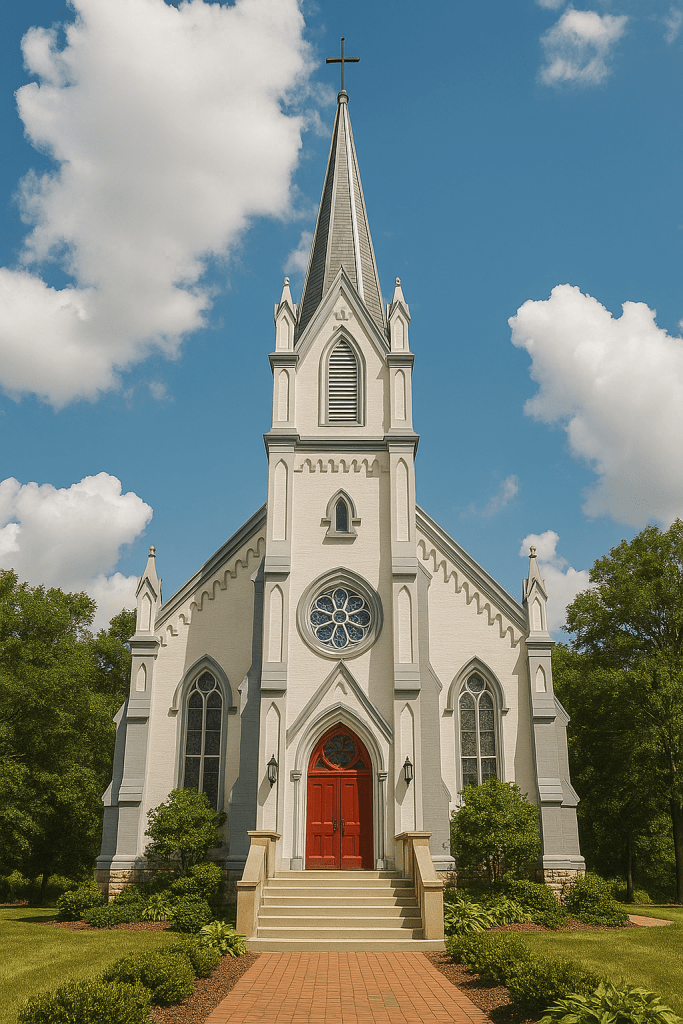
In every Hao Tangkhul village today, the skyline is marked by rising church buildings – strong, beautiful, and often the most prominent structures in our communities. These buildings stand as symbols of unity, progress, and faith. Yet, beneath the shining tin roofs and painted walls, a troubling question lingers:
Have we become more devoted to the Church we build than to the faith we profess?
1. From the Hills to the Cross
When the first missionaries reached the hills of the Tangkhuls, they brought not grand architecture but the simple Gospel – the story of love, forgiveness, and salvation through Christ. Our forefathers gathered under trees, in bamboo huts, and on open fields to worship. They had no electric lights or choirs with microphones, but their hearts burned with devotion.
They carried their faith in their hearts, not in their hands. Christianity then was a way of life, not a matter of Sunday attendance or committee positions.
Today, while we have grown materially and organizationally, our faith often feels decorated but hollow.
2. Building the Walls, Losing the Warmth
We pour immense energy into constructing new church buildings — collecting funds, debating designs, and even competing village to village over whose church looks more “modern.” In the process, we sometimes lose the spirit of humility and unity that the Church was meant to nurture.
Apostle Paul reminds us:
“Do you not know that you are God’s temple and that God’s Spirit dwells in you?” (1 Corinthians 3:16)
The true Church is not made of stone, cement, or iron , it is built of living souls bound together in love. When we spend more time maintaining walls than mending relationships, we miss the very essence of being the Body of Christ.
3. The Danger of a Decorative Faith
Many of us equate faith with visible achievements – buildings, events, sound systems, and decorations. But spiritual depth cannot be measured in square feet.
Christ Himself lived with simplicity. His ministry was not housed in temples, but in homes, hillsides, and hearts.
The early Tangkhul Christians, too, practiced faith in community life – sharing food, helping one another in harvest, and showing mercy to the poor. Today, our churches sometimes resemble administrative centers rather than compassionate homes of faith.
Jesus said,
“These people honor me with their lips, but their hearts are far from me.” (Matthew 15:8)
Are we not at risk of the same — singing hymns of faith while living lives of indifference?
4. Rebuilding the True Church
The time has come for us Hao Tangkhul Christians to rebuild, not just our physical churches, but our spiritual lives.
- Let us rebuild faith that moves beyond the walls.
- Let us restore fellowship that transcends denominational pride.
- Let us revive service that uplifts the weak and forgotten.
A church without love is a body without life.
A church without truth is a structure without a foundation.
If every believer becomes a living stone, shaped by prayer, humility, and compassion — then the Church of Christ will truly stand firm, whether or not the building remains.
5. Returning to the Builder
The Church we build must reflect the Builder we serve. Our purpose was never to glorify concrete, but to glorify Christ.
In the quiet of our hills, may we once again hear the whisper of faith our ancestors knew — that God dwells not in walls, but in willing hearts. Let our focus shift from what we build to who we become.
Then, perhaps, we will find again the living faith that once transformed our people — not by the strength of buildings, but by the power of belief.
Conclusion
The Church we build will one day fade, but the faith we live will endure through generations. As Hao Tangkhuls, may our Christianity not be measured by the height of our steeples, but by the depth of our love.
Let us remember: the truest church is not the one we enter every Sunday —
It is the one we carry within our hearts every day.
 Hao Tangkhul
Leave a comment