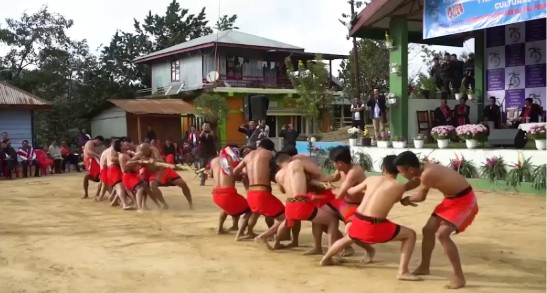
Based on their physical attributes, geographical location, and food habits, Hao Tangkhul Nagas are well-suited for sports that require high endurance, strength, and agility, particularly in rugged, hilly terrain. Traditional Tangkhul sports reflect this lifestyle, but their skills and physiology also lend themselves to modern athletic pursuits.
Hao Tangkhul traditional sports and related activities
Traditional Hao Tangkhul games are deeply intertwined with their way of life, emphasizing skills valuable for hunting, farming, and community life.
| Sport | Physical Requirements | Connection to Environment and Diet |
| Otrei Kaphung (Carrying a Giant Load) | Exceptional strength, balance, and endurance. | Directly mirrors the daily toil of carrying heavy loads of harvest and water over mountainous terrain. A diet of rice, protein-rich meat, and wild vegetables provides the necessary energy for such tasks. |
| Thingreira Khangakhun (Tug-of-War) | Raw physical strength, leg power, and coordinated teamwork. | This contest of strength reflects the community’s need for collective physical effort and social cohesion, a value reinforced by their communal, agrarian lifestyle. |
| High Jump | Agility, leg strength, explosive power, and timing. | Agility and swift reflexes are developed through navigating uneven, mountainous landscapes. The high-protein, nutrient-dense diet from meat and wild plants supports muscular development. |
| Archery | Upper body strength, hand-eye coordination, focus, and precision. | A skill honed for hunting in forested hills. It tests the accuracy and control necessary for survival. The sport rewards a steady hand and calm demeanour, mirroring the patience required for hunting. |
| Eagle and Hen game | Speed and agility, strength and stability, endurance and breathing control, coordination and teamwork, strategy & reflex | Hill-trained reflexes, Functional muscular power, High-altitude adaptation, Communal discipline, Tactical awareness |
| Hide and seek | Agility and speed, endurance and breathing, cognitive skills: observation and strategy, reflex and reaction, cultural symbolism and emotional intelligence | Quick directional changes, sprinting, Sustained running and stillness, reading environment, anticipating moves, Quick responses under surprise. |
| Bamboo Pole climbing | Strength, agility and balance, endurance, grip and core stability, mental focus and courage | Mountain-Hardened Muscles, Balance and Agility from Terrain, High Lung Capacity, Fearlessness and Determination, Communal Encouragement |
| Javelin Throw | Agility, strength, and mountain endurance; spear balanced on instinct | Spear was used in head hunting eras with precision, Warrior culture centred on survival and territory, Learned from youth through mock hunts and tribal games. |
Modern sports adaptations
The traits developed through their traditional lifestyle and activities make Hao Tangkhuls highly competitive in several modern sports.
| Modern Sport | Physical Demands | Comparative Advantage from Traditional Lifestyle |
| Long-Distance Running, sprinting and Trail Running | High cardiovascular endurance, lower body strength, and stamina. | The daily navigation of hilly terrain has naturally developed superior endurance and physical hardiness. Their lean, active build is ideal for these sports. |
| Football (Soccer) | Cardiovascular fitness, agility, speed, and teamwork. | The Hao Tangkhul passion for football is evidenced by local academies. It utilizes their high endurance and agility, and the emphasis on teamwork aligns with their community-oriented culture. |
| Weightlifting and Powerlifting | Exceptional overall body strength, particularly in the legs and back. | Traditional sports like Otrei Kaphung and Thingreira Khangakhun build a foundation of immense functional strength, which is directly transferable to powerlifting. |
| Wrestling | Grappling technique, balance, and upper body strength. | Their participation in Naga wrestling traditions demonstrates natural talent and cultural experience in combat sports. The grip strength and balance gained from navigating uneven terrain are also advantageous. |
| Basketball | Agility, vertical jump, and cardiovascular fitness. | Skills from high jump translate well to basketball. The sport also offers an alternative in urban settings where natural terrain is not available. |
| Badminton | high levels of speed, agility, strength, and endurance, requiring both aerobic and anaerobic fitness | Daily movement across uneven, steep terrain — from farms to forests — naturally trains fast reflexes, footwork, and muscular response. Navigating narrow mountain paths, terraced fields, and forest trails builds body coordination and balance. Activities like hunting, climbing trees, or performing communal dances demand rapid shifts in direction and precise body control. |
| Javelin Throw | Explosive Power (Legs, Core, Shoulders), Coordination & Timing, Balance & Posture, Flexibility & Mobility. | Daily life in the highlands builds functional muscle power ideal for throwing sports, Adaptation to hilly environments translates into better kinetic stability, Ancestral spear handling mirrors the biomechanics of modern javelin throws, the hunter’s calm concentration is mirrored in the athlete’s mental preparation. |
| Archery | Upper body strength, hand-eye coordination, focus, and precision. | A skill honed for hunting in forested hills. It tests the accuracy and control necessary for survival. The sport rewards a steady hand and calm demeanour, mirroring the patience required for hunting. |
Comparative analysis of suitability
Hao Tangkhuls are particularly well-suited for a range of sports due to the intersection of their genetic heritage, environmental adaptation, and diet.
| Factor | Suitability for Endurance Sports (Running, Football) | Suitability for Strength Sports (Weightlifting, Wrestling) |
| Physical (Hilly Habitat) | Excellent. Their daily life involves navigating steep slopes, building superior leg strength, and exceptional lung capacity. | Strong. While not their primary focus, the functional strength developed from farming and carrying loads provides a solid base. |
| Physical (Diet) | Very Good. Traditional food is high in carbohydrates (rice), protein (meat), and vitamins from wild vegetables, fuelling long-term energy needs. | Excellent. The emphasis on protein from meat, both farmed and hunted, directly supports muscle development. |
| Location (High Altitude) | Excellent. Training at Ukhrul district, which is at a high altitude, increases red blood cell count and improves athletic performance at lower elevations. | Excellent. The reduced oxygen levels at altitude force the body to adapt and build greater strength and power, an effect that can be leveraged for strength training. |
| Cultural (Communal Life) | Excellent. Team sports like football align perfectly with Hao Tangkhul values of cooperation and community cohesion, as seen in their traditional games. | Excellent. Traditional games like tug-of-war reinforce the importance of collective effort and strength, values that support success in both individual and team strength-based sports. |
The Hao Tangkhul Nagas possess a unique combination of genetic endurance, environmental conditioning, and cultural discipline that naturally positions them as strong contenders in both traditional and modern athletic pursuits. Their mountainous homeland – demanding constant movement across steep, uneven terrain – has honed their leg strength, lung capacity, and physical resilience, while their nutrient-rich traditional diet sustains stamina and muscle development.
Traditional Hao Tangkhul sports such as Otrei Kaphung, Thingreira Khangakhun, and Bamboo Pole Climbing are not mere recreational activities but embodiments of survival, skill, and community cooperation. These age-old practices have unknowingly served as a natural training ground for endurance, agility, and strength – the very attributes prized in modern athletics.
As Tangkhuls increasingly engage in sports like football, long-distance running, weightlifting, and badminton, they carry forward the essence of their heritage: discipline, courage, teamwork, and adaptability. Their traditional lifestyle offers a physiological and psychological edge – the endurance of a hill farmer, the precision of a hunter, and the spirit of a communal athlete.
In essence, the Tangkhul people are not only culturally athletic but biologically and environmentally primed for excellence in a broad spectrum of sports. By combining indigenous wisdom with modern training and facilities, they have the potential to produce world-class athletes who embody both the heritage and the future of Tangkhul physical culture.
Mirinsing Angkang
 Hao Tangkhul
Leave a comment