The Hao-Wung(Tangkhul) Nagas are one of the largest ethnic groups among the Nagas inhabiting the Indo-Myanmar border area. Since time immemorial, the Hao-Wung Nagas have been associated with nature, and were engaged in animism which varied from village to village.
The beautiful country of the Hao-Wung (Tangkhul) Nagas has been bestowed with innumerable natural resources and geological heritage sites. Some of the notable sites are the Khangkhui Mangsor, the Limestone at Hundung, and the Phangrei Kaphung. Amongst these, Khangkhui Mangsor is one of the most significant Geo-Heritage Sites (GHS). Geo-Heritage Sites (GHS) are geo-historical features of significant cultural imprint which provides deep insights into the earth’s evolution through space and time. Also, Geo-Heritage Sites (GHS) has a significant value that justify their conservation and proper management. The Khangkhui Mangsor is the site where the first Paleolithic age of late Quaternary (between 75,000 and 10,000 years ago) tools were discovered. It was used as a shelter by the locals during World War II (Shimray-Personal Communications).
Keywords: Khangkhui Mangsor, Geo-Heritage, Heritage, Tangkhul, Hao-Wung, Paleolithic
Khangkhui Mangsor
Site Location: 25° 3′ 12.33836″, 94° 24′ 34.43811″
Elevation: 1767 mabove Sea Level
Location: Khangkhui Phungcham, Veikhang Area, Ukhrul.
The Khangkhui Mangsor at Khangkhui Phungcham, Veikhang Area, Ukhrul is one of the most significant geological and cultural sites of the Hao-Wung (Tangkhul) Nagas. It is located (25° 3′ 12.33836″, 94° 24′ 34.43811″) 15 km south east of Ukhrul District Headquarters. The nearest airport to the Mangsor is Imphal International Airport and railway station is Dimapur. Khangkhui Mangsor is a cave system in a Cretaceous limestone. The Khangkhui Mangsor is formed by the dissolution of limestone. Rainwater which picks up carbon dioxide from the air and as it percolates through the soil turns into a weak acid. This slowly dissolves the limestone along the joints, bedding planes and fractures, with time it became large enough to form the cave. Khangkhui Mangsor is made of several natural voids varying in sizes from few to several metres. The voids are connected by several passageways. It has a pit with a diameter of 5 m and a depth of 30 m, which is called Shirata (falling star hole) in Hao-Wung (Tangkhul) dialect.
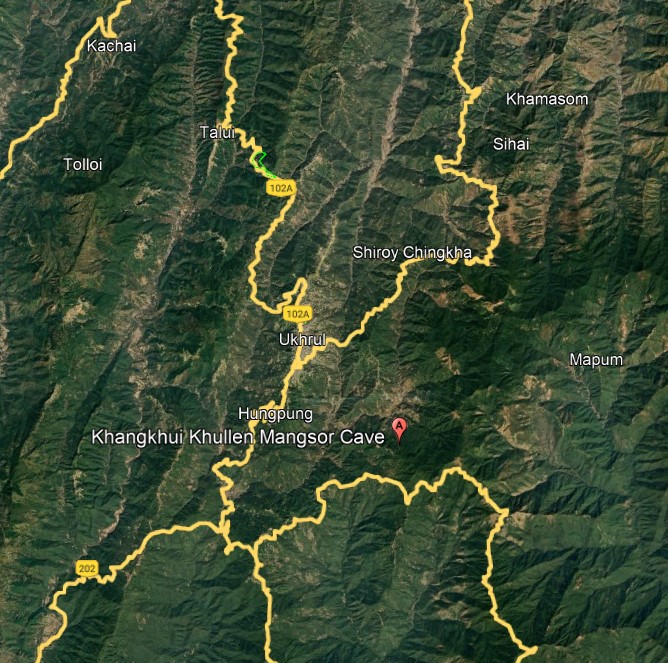
Figure.1:Google earth Imagery of location of Khangkhui Mangsor
According to a folklore, a Kameo (spirit deity) named Mangsor-Wung had two wives and chambers were built for them. The first chamber is for the first wife and the next chamber is christened as second wife chamber, because the King erected it for his second wife (Shimray-Personal communications).
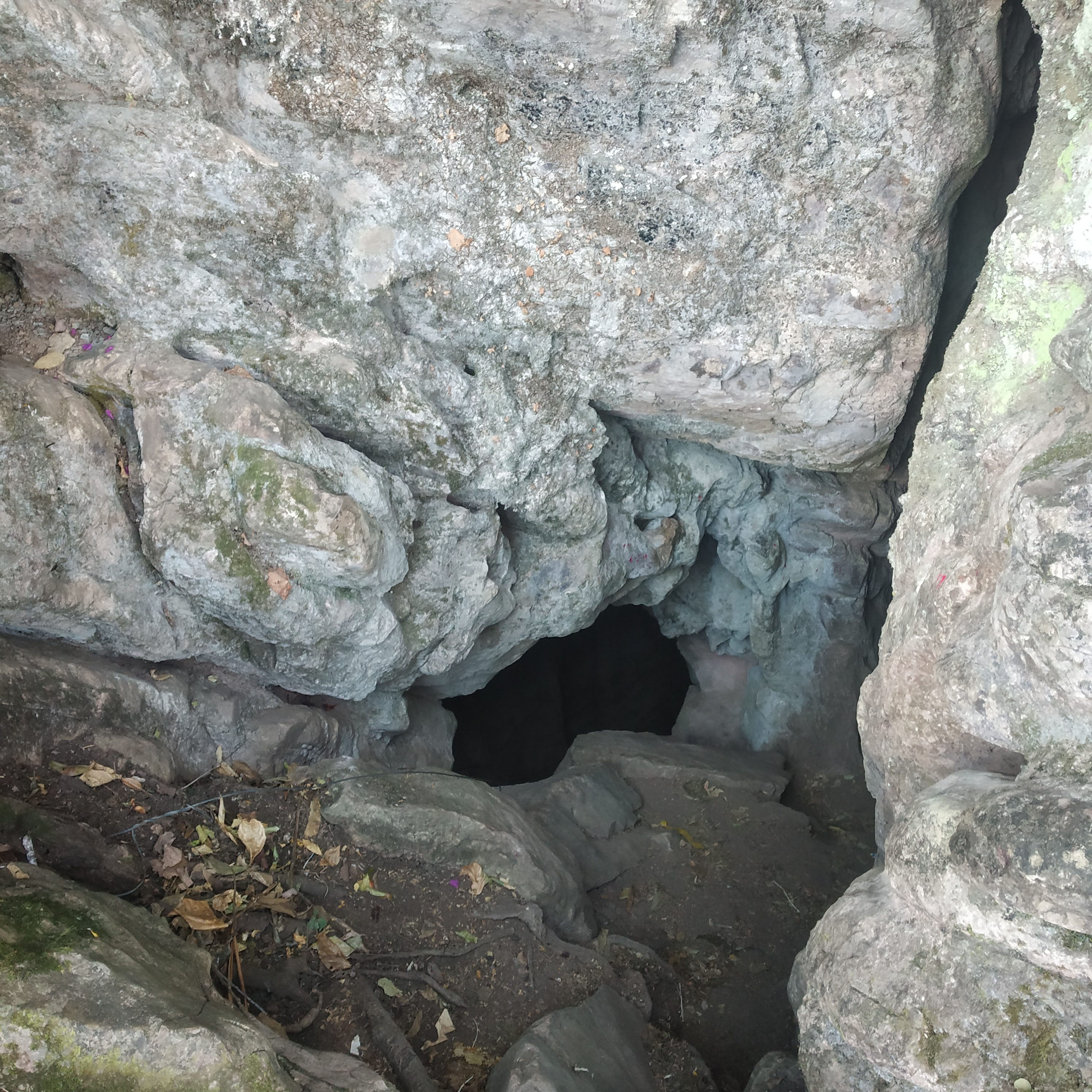
Figure.2: A photograph of an entry into Khangkhui Mangsor
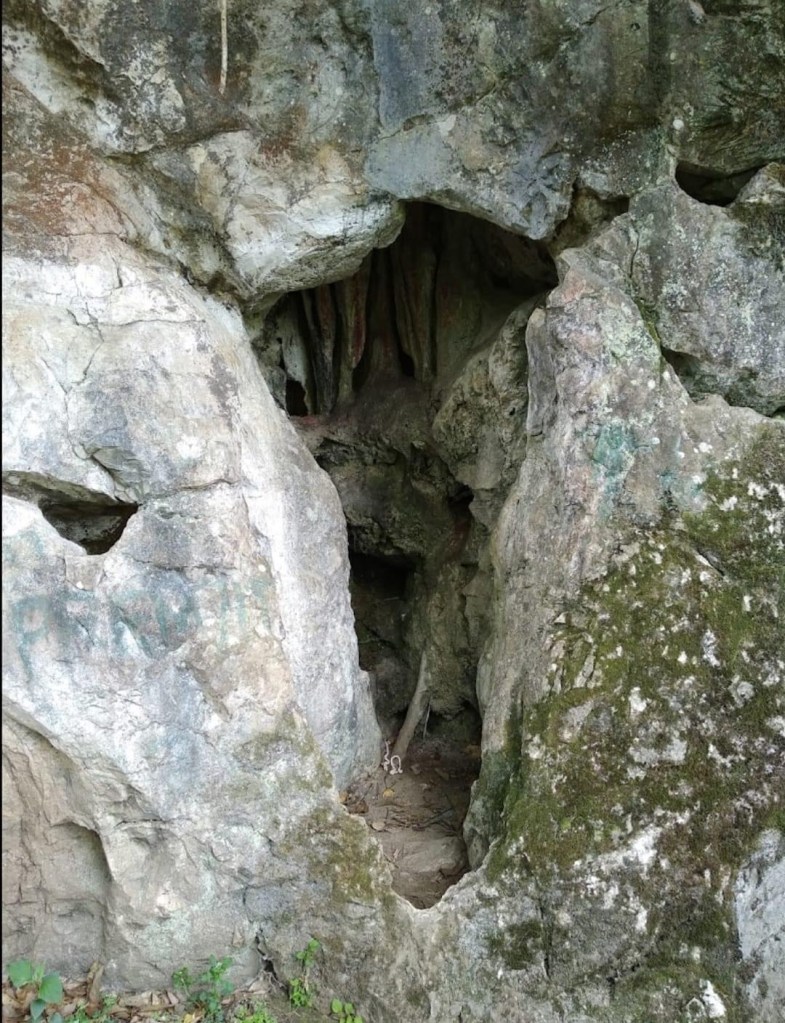
Figure.3: A photograph of an exposure of limestone with Stalactite at Khangkhui Mangsor (located at the North eastern part of the Khangkhui Mangsor)
The Hao-Wung Nagas believed that they came out of a cave in the earth at a place called Murringphy in the hills (Hudson 1911). Regarding the location of this traditional cave, R. Brown (Political Agent of Manipur 1867-1875), said that the cave called Murringphy is located in the hills about four days journey North-east of the Manipur Valley”. Dr Brown states that the origin of the Hao-Wung Nagas is thus given by Hao-Wung (Tangkhul) Nagas themselves. The veracity of this claim that Hao-Wung (Tangkhul) Nagas come out of the cave (now called Khangkhui Mangsor) north-east of Manipur valley has been rejected by W Ibohal on scientific grounds” (Shimray 2016).
Khangkhui Mangsor -The Oldest human civilization in Manipur state?
In Manipur, Khangkhui Mangsor (discovered in 1969) in Ukhrul District, Songu Cave(discovered in 1983) in Chandel District, Machi in Chandel District and Nongpok Keithelmanbi in Senapati District are significant sites where material remains of the Palaeolithic Age are found. Most of these systematic archaeological excavations of the Palaeolithic sites were done by the renowned Archaeologist and Anthropologist, O. Kumar. O. Kumar published his researches after combining all the archaeological findings entitled Archaeology of Manipur (1988). It was after the publication of the findings of the archaeological studies by him, that Manipur was included in the pre-historic map of India.
According to O. Kumar, human settlement in Manipur began since the pre-historic times, and the earliest settlement took place in the hills, particularly in the Songu cave in Chandel and Khangkhui Mangsor in Ukhrul District. At the end of the Pleistocene era (approximately-11000 years ago), very likely, due to temperature differences or other circumstances, primitive people came down to the lower altitude near the periphery of the valley. Singh(1998) concludes that the present archaeological evidences show that the Neolithic people populated the valley as early as about 2000 BC.
O. Kumar, during his excavation undertaken at Khangkhui caves in 1969, discovered large number of pre-historic artefacts from two of the caves. Excavations at the caves yielded many stone and bone tools along with fossilized faunal remains of Cervus, sus, bovine, etc. The stone tools were mostly flake and blade tools, along with few core tools. According to O. Kumar, the stone tools found at Khangkhui caves, are comparable to that of Choukoutien Cultures of China. It may be recalled that Choukoutien site is where the first specimens of Homo erectus, popularly called Peking man, was discovered (Lan-Po 1973). Scrapers, points, burins, borers, knife, etc. are the main flake tools. Most of the tools were made of limestone, while a few were made of quartz, sandstone and chert. The bone tools comprise of points, scrapers, chisels, perforated and blunted back knife. A big chopping tool with a handle of unique type was also collected on the western slope (Singh 1988). Thus, from the above descriptions and findings, it is evident that the antiquity of Khangkhui Mangsor goes back to that of late Quaternary (between 75,000 and 10,000 years ago) (Devi 1988).
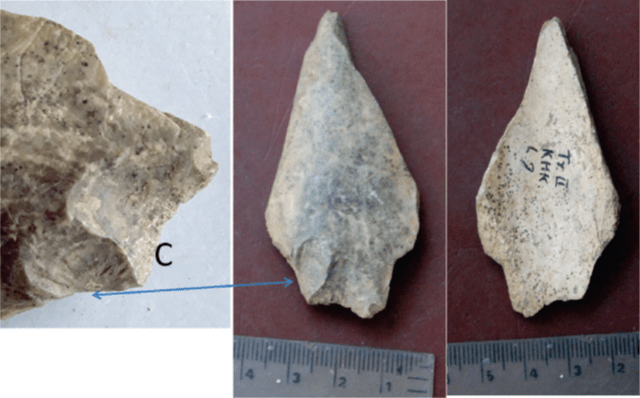
Figure.4: A bone point of Khangkhui cave no.3: A, dorsal view; B, ventral view & C, an enlarged view of the tang showing the snapping scars (After Singh 2021)
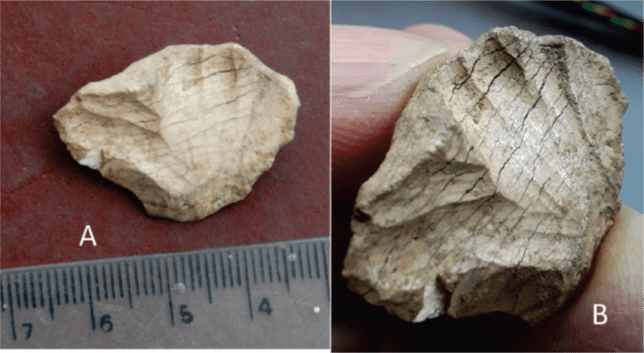
Figure.5: A bone scraper (scale in centimetre) & B, an enlarged view showing the presser flaking scars (After Singh 2021)
Chihui Kong of Khangkhui, which is a tributary of the Thoubal River, flows near the western hillock, made the Khangkhui area suitable for human habitation and settlement. Archaeologist, T.C. Sharma also points out that the remains found at the Khangkhui caves were of Upper or Late Palaeolithic phase (Sharma 1985).
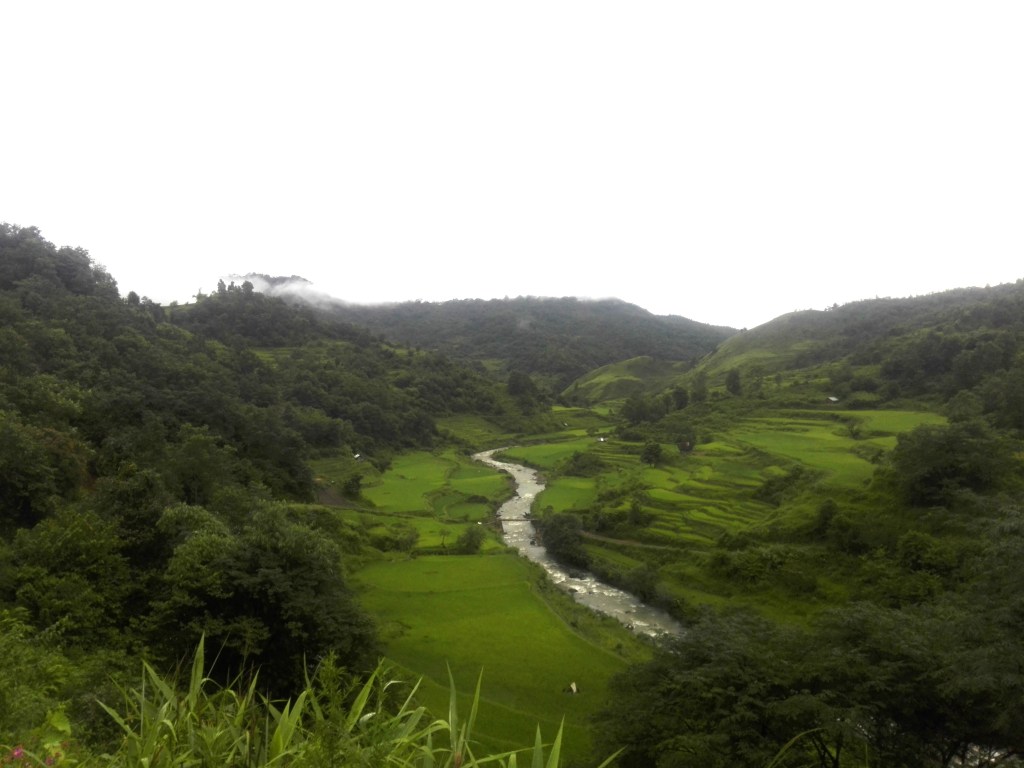
Figure.6: Chihui Kong at Khangkhui which is a tributary of Thoubal River
Geologically, Khangkhui Mangsor limestone deposits are small limestone deposits located in south eastern part of the Ukhrul district headquarters occurring within upper part of Disang Group. The Disang Group of rock where the Khangkhui Mangsor site is of the age Palaeocene to Eocene (66-33.9 million of years ago). Limestone at Khangkhui occurs as hillock about 15 km southeast of Ukhrul town. The limestone is a cone shaped body occupying a base area of 2500 sq.m, massive, jointed and having many cavities. The Mangsor has numerous stalactites and stalagmites ranging in centimetres to metres, even columns are also observed at places. The limestone occurs in white, pink and grey shades, with a strike N65°ES65° W and dip 10°-15° southeasterly. Probable reserve estimated is 2,60,000 tonnes. The average chemical composition of Khangkhui limestone is given in Table (GSI 2011).
| Compositions | Khangkhui Limestones |
| CaO | 47.74 % |
| MgO | 1.00 % |
| R2O3 | 2.37 % |
| Fe2O3 | 10.71 % |
Table.1: Average chemical composition of Khangkhui limestone Deposits (After GSI 2011)
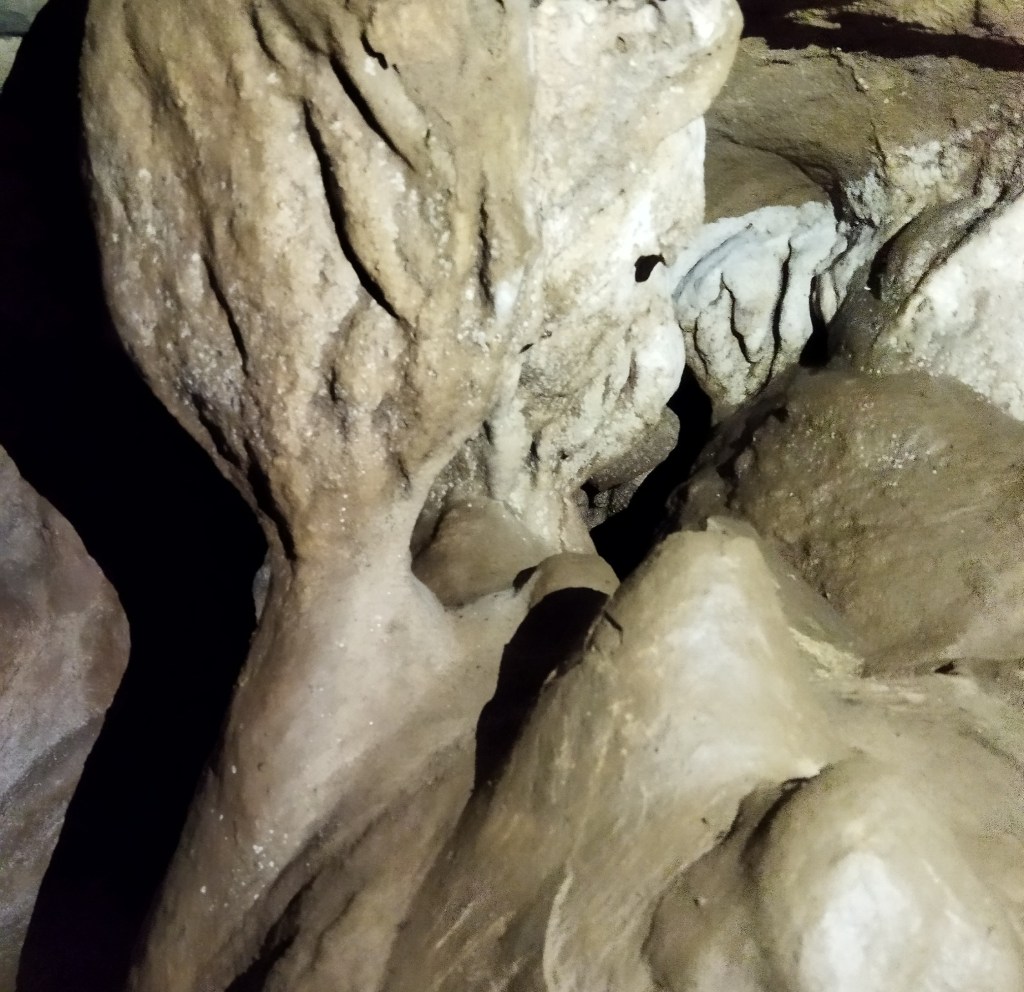
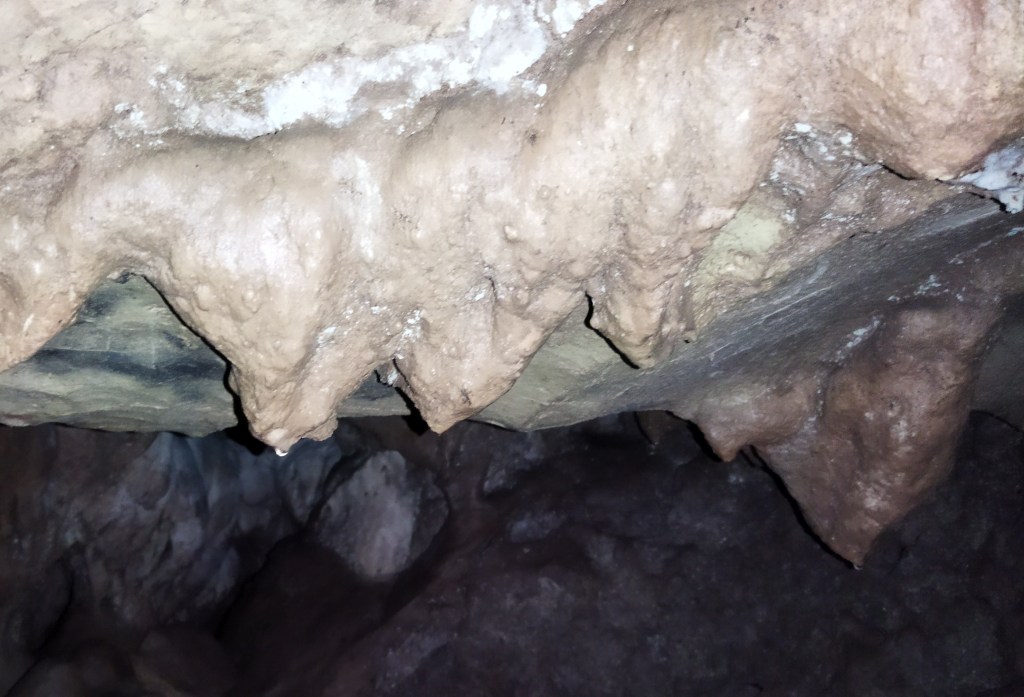
Figure.7: Stalactite and Stalagmites inside the Khangkhui Mangsor
It may also be added that recently, Zoological Survey of India(ZSI) recorded Blyth’s horseshoe bat in the Khangkhui Mangsor during two extensive field surveys in 2019 and 2021.This bat is one of 12 new species added to Manipur’s mammalian fauna.
Khangkhui Mangsor being the oldest and the first Paleolithic site of the Hao-Wung (Tangkhul) Nagas which has worldwide significance needs more detailed study with high-end scientific and historical datas. In-situ preservation of tools, bones and other significant findings from the excavated sites must be promoted. It is disheartening to observe that the stalactites and stalagmites have been broken by visitors and unwanted graffiti been drawn on the wall of the cave. Equally disturbing is the sight of plastics waste littering the surroundings. The Anthropogenic factors contributing to the degrading and pollution of the GHS must be strictly looked into. Hao-Wung (Tangkhul) Nagas must wake up to the call for identification, preservation, protection and maintenance of Geo-Heritage Sites and natural resources in the face of specific threats. It is never too late to initiate and act before irreversible damage befall us. The services of recognized institution such as Tangkhul Geoscience Forum (TGF) and intellectuals working on archaeology, anthropology and geology may be utilized for conservation, management and research of important Geo-Heritage Sites. Proper planning must be initiated at the grassroot level so that geo-tourism will improve with special focus on local festivals, customary and cultural activities. Certain laws should be enacted for the conservation and protection of all the potential Geo-Heritage Sites (GHS) at community level as well.
NB: This article was contributed by the Author to KHANRIN Magazine, A publication of Tangkhul Katamnao Long Delhi.
Citation: Angkang M (2023) A short note on Khangkhui Mangsor -A Geo-Heritage Site of the Hao-Wung Nagas. In:
Khanrin Magazine, Zimik L(ed) Tangkhul Katamnao Long Delhi (TKLD)
References
Devi L.K. (1988) A study of Archaeology in Manipur since Prehistoric Times, Thesis Submitted to Manipur University, Imphal. (P-10-13)
GSI (2011) Geology and Mineral Resources of Manipur, Mizoram, Nagaland and Tripura Geological Survey of India Miscellaneous Publication No. 30 Part Iv, Vol 1(Part-2)
Hudson T.C. (1911) The Naga Tribes of Manipur, P. 10
Kashung N (2016) Tracing the origin of Tangkhul Nagas through oral tradition/folksongs- Part 1 -Dr Ningreishim Shimray
Lan-Po Zia (1975), “The cave Home of Peking Man’Pp.38-44: New Archaeological finds in China (Discoveries during the cultural revolution), P.2
Singh O.K (1988) Archaeology of Manipur (1988)
Singh O.K (2021) Re-Evaluating the Bone Tools in the Forager Tool-Kits of Khangkhui Cave No. 3, Ukhrul District, Manipur, India. Journal of History, Art and Archaeology, 1: 2, pp. 137-142
Sharma T.C (1985) “Studies in the Sources of Pre-History of Manipur and Nagaland” pp. 13-18 in SN Pandey (ed.) Sources of the History of Manipur, Imphal: Manipur University
 Hao Tangkhul
Leave a comment